Watts and watt-hours are the two numbers on every power station spec sheet, and mixing them up is one of the most common reasons people buy the wrong size. This guide is the plain-English explanation PowerMatchLab's other guides link back to.
Short version: watts is a rate, watt-hours is a total. Everything else follows from that distinction.
Watts (W): a rate of power, not an amount
A watt measures how much power something draws or delivers at a given instant — it's a rate, the same way miles per hour is a rate of speed. A 100 W device pulls 100 watts whether it runs for one minute or ten hours; the watt figure itself doesn't change with time.
On a power station, the watts figure appears as a continuous output rating (how much it can deliver steadily) and a surge or peak rating (how much it can deliver briefly, for motor startups).
Watt-hours (Wh): an amount of energy over time
A watt-hour is energy — watts multiplied by the hours they're sustained. A 100 W device running for 3 hours uses 300 Wh, regardless of how that power was delivered moment to moment.
A power station's battery capacity is rated in watt-hours (or often kilowatt-hours, kWh — 1,000 Wh). That number tells you how much total energy is stored, which determines how long it can run something once that something is actually running.
Why mixing them up leads to the wrong purchase
A device's watts tells you whether a station can start and run it at all — check that against the station's continuous and surge output. A device's watt-hours (watts × hours of use) tells you how long the station's capacity will sustain it — check that against the battery's usable Wh.
Buying based on only one of the two numbers is the classic mistake: a station with plenty of watt-hours but too low a watt rating can fail to start a device entirely, while a station with a high watt rating but modest watt-hours can start anything but run out quickly.
Converting between the two
Watt-hours = watts × hours of use. If you only know amps and volts (common on rating labels), watts ≈ amps × volts, and you can convert from there.
Working the other direction: hours of runtime ≈ usable battery Wh ÷ device watts. PowerMatchLab uses roughly 85% of nameplate capacity as usable energy in its own runtime and sizing calculations, to account for inverter and conversion losses.
Typical wattage ranges for common devices
These are broad, commonly cited category ranges, not a measurement of any specific product — always check your own device's rating label or manual for its real figure.
- Phone or small USB device charging: roughly 5-20 W
- Laptop: roughly 30-100 W
- LED TV: roughly 30-150 W depending on size
- Box fan or CPAP machine without a heated humidifier: roughly 30-60 W
- Full-size refrigerator (average, cycling): roughly 100-200 W average, with a startup surge several times higher
- Microwave or coffee maker: roughly 600-1,200 W
- Space heater or hair dryer: roughly 750-1,800 W
Continuous watts vs. surge watts
Continuous watts is what a device draws while running steadily. Surge (or peak/startup) watts is a brief spike, common in anything with an electric motor — a compressor, a pump, a power tool — often two to three times the running watts for a fraction of a second.
A power station's surge rating needs to clear a device's startup spike, not just its running watts, or the device may fail to start even though the continuous rating looked sufficient.
Put a number on it
Related products
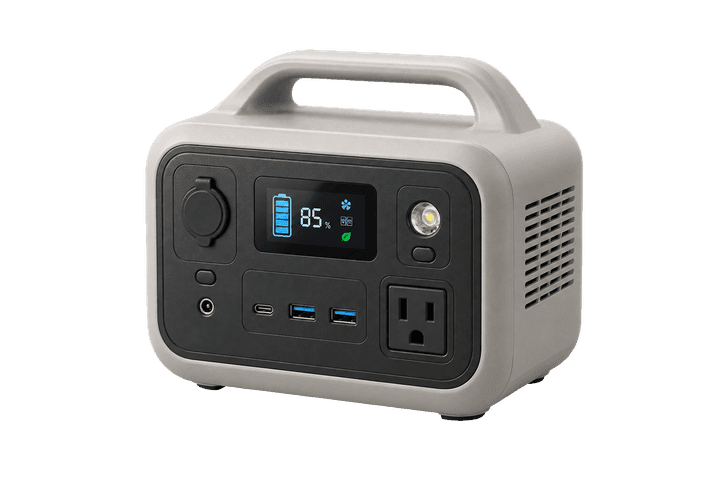
Illustrative image — not an exact product photograph.
- Capacity
- 288 Wh
- Output
- 600 W
- Weight
- 4.3 kg
Best for: camping, day trips, laptops and electronics, light emergency backup
Price, availability and current rating are shown on Amazon — PowerMatchLab does not display them because we have not independently verified them. As an Amazon Associate we may earn from qualifying purchases.
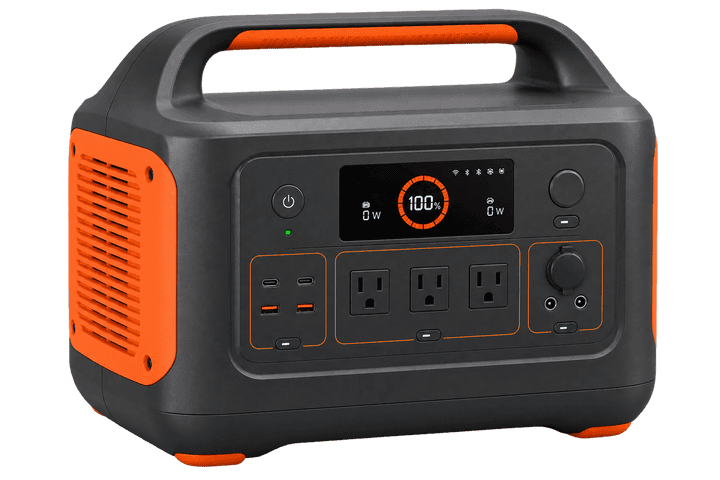
Illustrative image — not an exact product photograph.
- Capacity
- 2,042 Wh
- Output
- 2,200 W
- Weight
- 17.9 kg
Best for: home backup, refrigerator and freezer backup, RV use, camping
Price, availability and current rating are shown on Amazon — PowerMatchLab does not display them because we have not independently verified them. As an Amazon Associate we may earn from qualifying purchases.
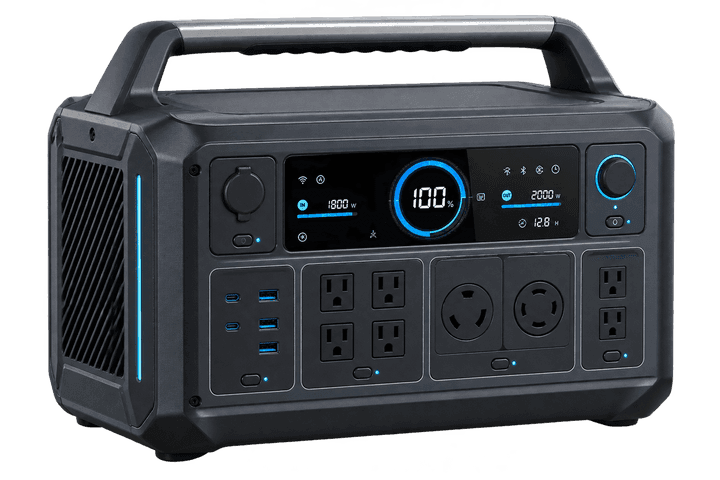
Illustrative image — not an exact product photograph.
- Capacity
- 2,010 Wh
- Output
- 1,500 W
- Weight
- 16.2 kg
Best for: refrigerator backup, extended home essentials, camping, low-load long runtime
Price, availability and current rating are shown on Amazon — PowerMatchLab does not display them because we have not independently verified them. As an Amazon Associate we may earn from qualifying purchases.
Related guides
FAQ
- If a power station is rated 1000Wh, does that mean it outputs 1000 watts?
- No — those are two different specs. Wh (or kWh) is total stored energy; W is the rate of power it can deliver. A station's continuous output watts is a completely separate number, usually listed right next to the capacity on its spec sheet.
- How many watt-hours does charging a phone use?
- A full phone charge is typically a small fraction of most power stations' capacity — commonly in the 10-20 Wh range, though it varies by phone and charger. Check your charger's rated watts and your phone's typical charge time for a more precise figure.
- Why do two power stations with the same watt-hour rating feel different in practice?
- Usable energy (after inverter/conversion losses), continuous and surge output ratings, and how efficiently the inverter handles your specific load can all differ between units with the same nameplate Wh — capacity alone doesn't tell the whole story.
Sources
- U.S. Department of Energy — Estimating Appliance and Home Electronic Energy Use
- Manufacturer specification sheets referenced in products.json
Last updated September 3, 2026. This guide is educational and general; it does not assert product-specific performance beyond what products.json verifies. PowerMatchLab may earn a commission from Amazon links once the Associates programme is active — see the disclosure.