"Home backup" covers a wide range, from keeping the fridge, internet and a few lights on during a short outage to running most of a house for days. This guide helps you figure out which one you actually need before you size anything.
The math is the same watts-vs-watt-hours method used throughout PowerMatchLab, applied to a whole household's essential circuits instead of a single appliance.
Step 1: Decide what "backup" means for your household
Start by naming the circuits or devices you actually need through an outage: refrigerator, freezer, internet router and modem, a few lights, phone charging, medical equipment, a sump pump, maybe a window AC or a well pump. Write the list down before looking at any product.
A portable power station is generally an essentials device, not a whole-house generator replacement — sized realistically, it comfortably covers a defined list of priority loads rather than every circuit in the home.
Step 2: List each load's running watts
For every item on your list, find its running watts from its rating label or manual, or measure it with a plug-in energy meter. Don't estimate — a router might be 10-15 W while a window AC can be several hundred to over a thousand.
Note anything motor-driven (fridge, freezer, sump pump, well pump, some AC units) separately — these have a startup surge well above their running watts, covered in Step 4.
Step 3: Estimate total daily energy
Multiply each load's watts by how many hours per day you expect to run it, then add every load together for a daily watt-hour total. A fridge alone commonly uses roughly 1,000-1,600 Wh/day; add your other essentials on top.
As a broad planning reference, a household running a compact essentials list — fridge, internet, phones, a few lights — often lands somewhere around 2,000-4,000 Wh per day, but your own list may be higher or lower; there is no substitute for adding up your own numbers from Step 2.
Step 4: Convert to a recommended capacity
Using the same assumptions as the rest of PowerMatchLab — about 85% usable energy after conversion losses, plus roughly 20% reserve headroom: recommended minimum capacity (Wh) ≈ (daily energy Wh × days of autonomy) ÷ 0.85 × 1.2.
Worked example: your essentials list adds up to 2,500 Wh/day, and you want to plan for one full day without recharging. 2,500 ÷ 0.85 × 1.2 ≈ 3,529 Wh minimum recommended capacity. A two-day plan without recharge roughly doubles the daily-energy figure before the same adjustment.
Multi-day, no-recharge scenarios get large fast — this is where an expandable platform (add battery modules instead of buying a second unit) or a recharge plan (generator, solar, or grid access) usually makes more practical sense than one enormous fixed battery.
Step 5: Confirm continuous output and surge headroom
Add the running watts of everything that could be on at once — that's your required continuous output. Then add your single largest startup surge (typically the fridge or a pump) on top of everything else running, and check that total against the station's surge/peak rating.
Undersizing output is a common failure mode even when capacity looks fine on paper: a station with plenty of watt-hours can still trip or refuse to start a compressor if its continuous or surge watt rating is too low for what you're asking it to run at once.
UPS switchover time and 120/240V loads
If you want the station to take over automatically when the grid drops — keeping a desktop, networking gear, or certain medical devices running through the cutover — look for a fast switchover time, commonly in the 10-20 millisecond range on units that support it.
Well pumps, electric ranges, dryers and some HVAC equipment need 120/240V split-phase power. Only a subset of large power stations provide this natively; most output 120V only. Confirm this before assuming a station can cover a 240V appliance.
Power station vs. a standby or portable generator
A battery power station is silent, produces no exhaust, and needs no fuel — it can sit indoors and starts instantly. Its trade-off is finite capacity: once the battery is empty, you need to recharge it (grid, solar, or a generator) rather than just adding more fuel.
A fuel generator can run indefinitely as long as fuel lasts, at the cost of noise, exhaust (never run one indoors or in an attached garage), and maintenance. Many households use a power station for quiet, everyday-length outages and treat a generator, if they have one, as backup for genuinely extended events.
Connecting to your home's electrical panel
Some larger power stations support a transfer switch or a dedicated inlet that can back up selected circuits directly from the breaker panel. This is an electrical installation, not a plug-and-play setup, and should be done by a licensed electrician.
Put a number on it
Related products
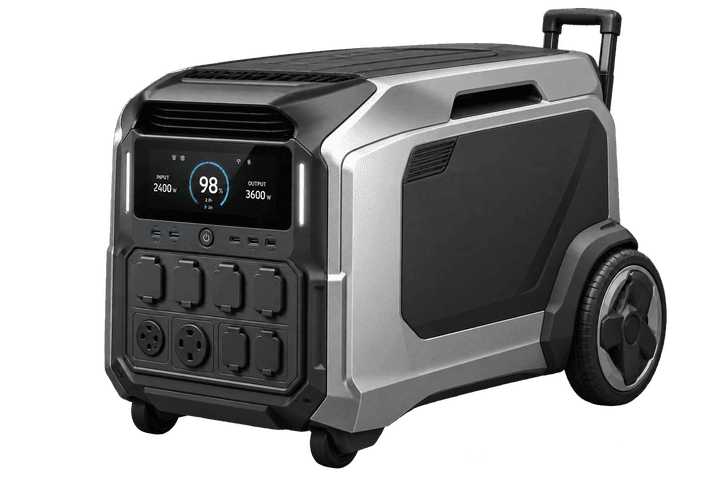
Illustrative image — not an exact product photograph.
- Capacity
- 4,096 Wh
- Output
- 4,000 W
- Weight
- Not verified
Best for: whole-home backup, RV, 240V appliances, extended outages
Price, availability and current rating are shown on Amazon — PowerMatchLab does not display them because we have not independently verified them. As an Amazon Associate we may earn from qualifying purchases.
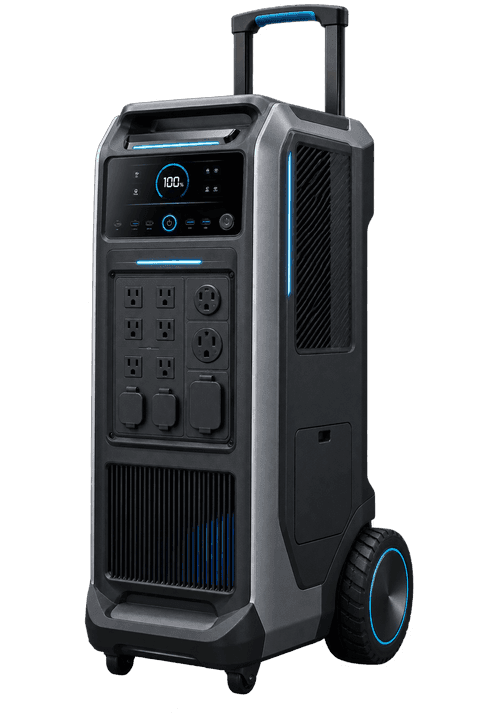
Illustrative image — not an exact product photograph.
- Capacity
- 3,840 Wh
- Output
- 6,000 W
- Weight
- 60 kg
Best for: whole-home backup, RV, 240V appliances, EV emergency charging
Price, availability and current rating are shown on Amazon — PowerMatchLab does not display them because we have not independently verified them. As an Amazon Associate we may earn from qualifying purchases.
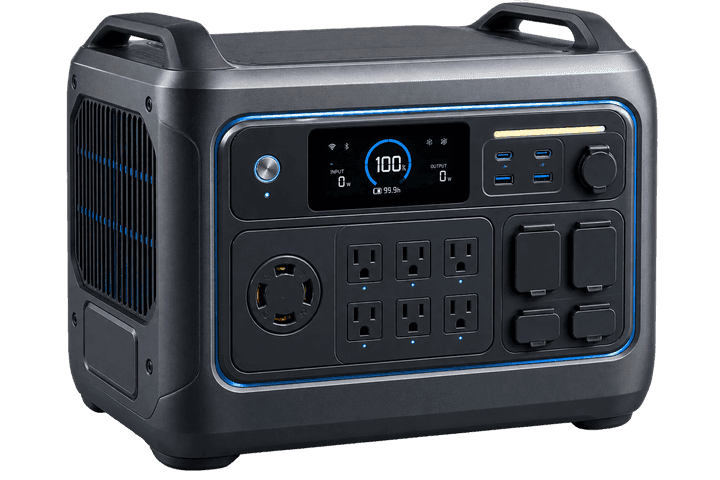
Illustrative image — not an exact product photograph.
- Capacity
- 2,048 Wh
- Output
- 2,400 W
- Weight
- 18.9 kg
Best for: RV, refrigerator backup, home essentials, camping
Price, availability and current rating are shown on Amazon — PowerMatchLab does not display them because we have not independently verified them. As an Amazon Associate we may earn from qualifying purchases.
Related guides
FAQ
- Can a power station really back up my whole house?
- For most households, no — a portable power station realistically covers a defined list of essential circuits (fridge, internet, some lights, phone charging, maybe a pump), not an entire home's simultaneous load. Whole-house coverage generally needs a much larger, professionally installed system.
- How much capacity do I need for a 24-hour outage?
- Add up the daily energy of the specific loads you want to keep on (Step 3), then apply the 85% usable-energy and 20% reserve adjustments from Step 4. Essentials-only lists commonly land in the low thousands of watt-hours per day, but your own list is the number that matters.
- Do I need 240V?
- Only if you have a specific 240V load you want to back up directly, like a well pump, electric range, or dryer. Most households running fridge/internet/lights/phones-class essentials only need 120V.
- Should I buy one large station or two smaller ones?
- One larger unit is simpler and generally more energy-efficient. Two smaller units add redundancy and flexibility — useful if you want to back up two separate areas — but cost more per Wh and take more space.
Sources
- U.S. Department of Energy — Estimating Appliance and Home Electronic Energy Use
- Manufacturer specification sheets referenced in products.json
Last updated September 3, 2026. This guide is educational and general; it does not assert product-specific performance beyond what products.json verifies. PowerMatchLab may earn a commission from Amazon links once the Associates programme is active — see the disclosure.