By PowerMatchLab Editorial · Last updated September 6, 2026
Short answer: for indoor use, the safe option is a battery-based power station, used according to its manufacturer's instructions — not a fuel-burning generator. A gasoline, propane, or other fuel-burning generator must never be run inside a house, garage, basement, shed, or any other enclosed or partially enclosed space, even with doors or windows open.
"Indoor generator" is a common search term, but no fuel-burning generator is actually safe indoors — what most people searching for one actually need is a way to keep a refrigerator running from inside the house without exhaust, noise, or a fuel supply. This guide covers the safety distinction, what "generator" vs. "power station" terminology actually means, and how to size a battery station for a fridge.
Key takeaways
- A battery power station has no exhaust and can be used indoors following its manufacturer's instructions; a fuel-burning generator must never run indoors, in a garage (even with the door open), or near windows and doors.
- "Generator," "power station," and "solar generator" are often used interchangeably in marketing for the same battery-and-inverter device — but only the battery-based version is safe indoors.
- Sizing still comes down to the same two checks as any power station: surge output to start the compressor, and watt-hours for how long it needs to run.
- A roughly 1 kWh station does not automatically mean a full day of runtime — inverter losses, temperature, door openings, and the fridge's own age and cycling all change the real number.
- Recommended capacity ≈ (daily energy Wh × days of autonomy) ÷ 0.85 usable-energy × 1.2 reserve — the same formula used throughout PowerMatchLab.
What people usually mean by "indoor generator"
Strictly speaking, there is no such thing as a safe indoor fuel-burning generator — every gasoline, propane, diesel, or dual-fuel generator produces carbon monoxide and must run outdoors, away from the home. When someone searches for an "indoor generator for a refrigerator," they are almost always describing what they actually need: a way to keep a fridge running from inside the house without exhaust, noise, or a fuel supply, which is exactly what a battery-based power station provides.
This mix-up is common because product listings use overlapping language — "generator," "power station," and "solar generator" often describe the same battery-and-inverter device. PowerMatchLab's dedicated guide on that terminology, Solar Generator vs. Portable Power Station, explains the distinction in more depth.
Battery power station vs. fuel-burning generator
A battery-based power station stores electricity in a rechargeable battery and releases it through a built-in inverter — there is no combustion and no exhaust, which is why it can be used indoors when placed and ventilated according to its manufacturer's instructions.
A fuel-burning generator creates electricity by burning gasoline, propane, or diesel in a small engine, which produces carbon monoxide (CO), a colorless, odorless gas. That is true of every fuel-burning generator, regardless of size, brand, or how new it is — including units marketed as "quiet," "inverter," or "portable."
Why a fuel generator must never run indoors
The U.S. Consumer Product Safety Commission (CPSC) and the Centers for Disease Control and Prevention (CDC) both warn that a fuel-burning generator should never be operated inside a home, basement, garage, shed, or other enclosed or partially enclosed space — even with doors, windows, or vents open. Opening a door or window does not clear carbon monoxide fast enough to prevent it from reaching dangerous levels indoors.
Both agencies recommend running a portable generator outdoors, well away from doors, windows, and vents, and installing battery-powered carbon monoxide alarms in the home. See the official CPSC and CDC sources linked at the end of this guide for the full guidance.
A battery power station avoids this risk entirely because it has no engine and no exhaust — this is the core safety reason many households specifically look for an indoor-safe option to keep a refrigerator running.
Running watts vs. the compressor's startup surge
Whichever battery power station you consider, it needs to clear the same two checks as for any refrigerator: continuous output in watts to run the compressor, and a surge or peak rating to handle its startup spike, commonly two to three times the running watts for a brief moment. PowerMatchLab's feasibility guide, Can a Power Station Run a Refrigerator, and For How Long?, covers this surge check step by step.
Watt-hours and estimated autonomy
Once output is covered, the remaining question is capacity: how many watt-hours the station holds, and how long that covers your fridge. As a planning estimate, estimated runtime (hours) ≈ usable capacity (about 85% of rated Wh) ÷ the fridge's average running watts — the same formula used on every PowerMatchLab product page. This is a planning calculation, not a lab measurement or a guarantee.
The Power Calculator applies this same formula to your exact fridge and target runtime, and shows which catalog stations clear both the surge and capacity requirements — it already starts with a refrigerator pre-added as an example device, so you can edit its running watts and hours to match your own model directly.
Why a roughly 1 kWh battery doesn't automatically mean a full day
A common assumption is that a ~1,000 Wh-class power station covers a full 24 hours on a refrigerator. In practice it often covers considerably less, because several real-world factors reduce usable runtime below the simple nameplate-capacity number:
- Inverter and conversion losses — a station never delivers 100% of its rated capacity as usable AC power; PowerMatchLab plans around 85% usable energy for exactly this reason.
- Ambient temperature — a hot kitchen, garage, or porch makes the compressor run more, and battery capacity itself can be reduced in extreme heat or cold.
- Door openings — every time the door opens, warm air enters and the compressor has to work harder to recover, increasing energy use for that cycle.
- The fridge's age and condition — an older unit, a worn door seal, or a less efficient compressor can use meaningfully more daily energy than a new, efficient model.
- Compressor cycling — a fridge does not draw its running watts continuously; it cycles on and off, so its real daily energy use depends on how often and how long it cycles, not just its rated wattage.
Choosing roughly 1 kWh, 2 kWh, or larger
As a starting point: a ~1 kWh-class station is often enough for a shorter outage or a smaller fridge; a ~2 kWh-class station gives more comfortable margin for a full-size fridge over a full day; and a larger or expandable platform makes more sense for multi-day outages or when the fridge is one of several priority loads. These are starting points, not fixed rules — your fridge's own measured energy use is what should decide it.
PowerMatchLab's sizing guide, What Size Power Station Do I Need for a Refrigerator?, works through the exact watt-hour math for 8-hour, 12-hour, and 24-hour outages, using the same formula referenced above.
For today's ranked catalog picks evaluated specifically for this use case — capacity, surge rating, and other refrigerator-relevant fields — see PowerMatchLab's Best Power Stations for Refrigerator Backup page.
Recharging: wall power and solar
A battery power station recharges from a normal wall outlet, and many models also accept solar input. AC charging is the fastest option; solar can extend coverage during a multi-day outage, though real-world solar output is usually well below a panel's rated watts. PowerMatchLab's charging guide, Solar Input and AC Charging Specs, Explained, covers both in more depth.
Limits and precautions
A portable battery power station is generally an essentials device — sized realistically, it is not a replacement for a whole-house standby generator, and it has a finite capacity that must be recharged once used.
Even though a battery station produces no exhaust, always follow its manufacturer's manual for placement, ventilation, and operating temperature range — treat the manual as the authoritative source for your specific model, not this guide.
PowerMatchLab has not physically tested any product referenced here. Specifications shown for a given product come from that product's own manufacturer-published data, and any figure PowerMatchLab could not confirm is shown as "Not verified."
Why your real result may differ
These figures are planning estimates from the inputs and assumptions above — not a lab measurement. Your real result can vary with:
- Temperature — cold reduces usable battery capacity; heat can trigger throttling
- Battery age and condition — capacity fades gradually with cycles and time
- Inverter efficiency — some energy is always lost converting DC to AC
- Variable appliance draw — most appliances don't pull a constant wattage
- Startup/surge power — a motor's brief startup spike can exceed its running watts
- Appliance settings — e.g. humidifier, fan speed, or temperature setting
- Conversion losses beyond the modeled efficiency assumption
- Real solar conditions — actual panel output is usually well below its rated watts
- The safety reserve is a margin for error, not a guarantee
Put a number on it
Related products
These picks are focused on the U.S. market. Before buying, confirm plug type, voltage (120V), warranty terms, and regional availability on the Amazon listing — especially if you are ordering to another country.
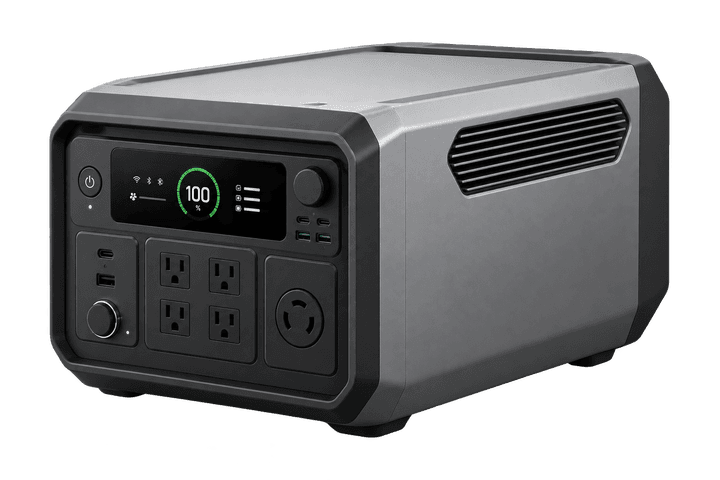
Illustrative image — not an exact product photograph.
- Capacity
- 1,024 Wh
- Output
- 1,800 W
- Weight
- 26.7 lb (12.1 kg)
Best for: home essentials, refrigerator backup, camping, electronics
Price, availability and current rating are shown on Amazon — PowerMatchLab does not display them because we have not independently verified them. As an Amazon Associate we may earn from qualifying purchases.
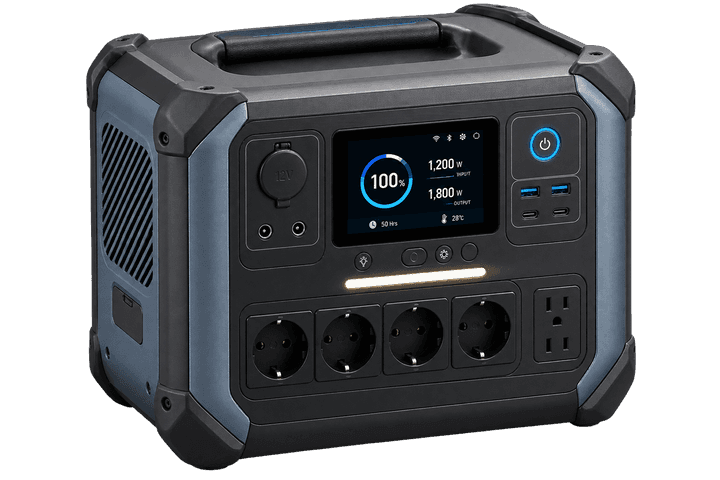
Illustrative image — not an exact product photograph.
- Capacity
- 1,024 Wh
- Output
- 2,000 W
- Weight
- Not verified
Best for: home essentials, camping, RV use, high-power appliances
Price, availability and current rating are shown on Amazon — PowerMatchLab does not display them because we have not independently verified them. As an Amazon Associate we may earn from qualifying purchases.
Related guides
FAQ
Can I use a battery power station inside my house?
Yes — a battery-based power station has no engine and no exhaust, so it can be used indoors when placed and ventilated according to its manufacturer's instructions. This is different from a fuel-burning generator, which must never be run indoors.
Is it safe to run a fuel generator in the garage with the door open?
No. The CPSC and CDC both warn that running a fuel-burning generator in a garage, even with the door open, can allow carbon monoxide to reach dangerous levels inside the home. Fuel generators must be run outdoors, away from doors, windows, and vents.
Will a 1 kWh power station run my fridge for a full day?
Not automatically. Inverter losses, ambient temperature, door openings, and your specific fridge's age and cycling behavior all affect real-world runtime. Measure your fridge's actual daily energy use with a plug-in energy meter for an accurate number, or use the Power Calculator as a planning estimate.
Do I need a whole-house generator just to keep the fridge running?
Not necessarily. A refrigerator's continuous and surge requirements are modest compared to a whole home's circuits, so a correctly sized portable battery power station is often enough on its own — see PowerMatchLab's sizing guide for the exact math.
Sources
- U.S. Consumer Product Safety Commission — Carbon Monoxide Fact Sheet
- Centers for Disease Control and Prevention — Carbon Monoxide Poisoning Basics
- ENERGY STAR — Refrigerators
- Manufacturer-published specifications, attributed by brand in products.json
Last updated September 6, 2026. This guide is educational and general; it does not assert product-specific performance beyond what products.json verifies. As an Amazon Associate, PowerMatchLab earns from qualifying purchases made through the Amazon links on this page — see the disclosure.