Solar charging time comes down to one calculation — energy needed divided by realistic panel output — but the "realistic" part is where most estimates go wrong. This guide walks through the formula and applies it to a few worked examples.
For the deeper explanation of what a station's solar input spec actually means and how AC and solar charging compare, see PowerMatchLab's solar input and charging guide, linked below.
The formula
Charging time (hours) ≈ energy needed (Wh) ÷ realistic solar input (W). "Energy needed" is however much of the battery's capacity you're actually replacing — a full charge from empty uses close to the full rated Wh, a partial top-up uses less.
"Realistic solar input" is the operative word — it is not simply the panel's rated wattage. Real-world output is reduced by sun angle, panel temperature, haze or cloud cover, cable losses, and time of day, and is commonly in the 60-80% range of the rated number on a good day.
Worked examples
A 200 W-rated solar panel realistically delivering 65% of its rating produces about 130 W in good midday sun. Charging a 1,000Wh station from empty: 1,000 ÷ 130 ≈ 7.7 hours of good sun — which in practice usually spans more than one calendar day, since few locations get 7-8 hours of consistently strong sun.
The same 200 W panel charging a 2,000Wh station from empty: 2,000 ÷ 130 ≈ 15.4 hours of good sun, realistically two to three days depending on conditions and how much of each day is strong, direct sun.
A larger 400 W-rated setup at the same 65% realistic derate produces about 260 W: 1,000 ÷ 260 ≈ 3.8 hours of good sun for the same 1,000Wh station — roughly half the time, since panel wattage and charging time scale inversely.
"Hours of sun" isn't the same as "hours of daylight"
A day has roughly 12-14 hours of daylight in much of the U.S. depending on season and latitude, but only a portion of that is strong, direct sun capable of near-peak panel output — early morning, late afternoon, haze, and cloud cover all reduce output well below peak.
Solar-charging estimates are usually expressed in "full-sun hours" or "peak-sun hours" for this reason — a rough count of how many hours of peak-equivalent sun a location gets, which is often meaningfully less than its total daylight hours.
What changes your real number
Panel angle and orientation relative to the sun, ambient and panel temperature (panels lose some efficiency when hot), shading (even partial shading on part of a panel string can cut output disproportionately), and the station's charge controller and maximum solar input spec all affect the real number.
Check the station's maximum solar input watts specifically — pairing it with a panel array rated well above that ceiling doesn't help, since the station simply won't accept more than its rated input regardless of what the panels could theoretically produce.
Solar vs. AC (wall) charging speed
AC charging from a wall outlet is almost always faster and far more predictable than solar, since it isn't subject to weather or time of day. Many people use solar for extending runtime during multi-day off-grid use and AC for the fastest full recharge when a wall outlet is available.
Some stations support charging from AC and solar simultaneously for a faster combined recharge — check the specific unit's combined-input limit rather than assuming the two simply add together without a cap.
Put a number on it
Related products
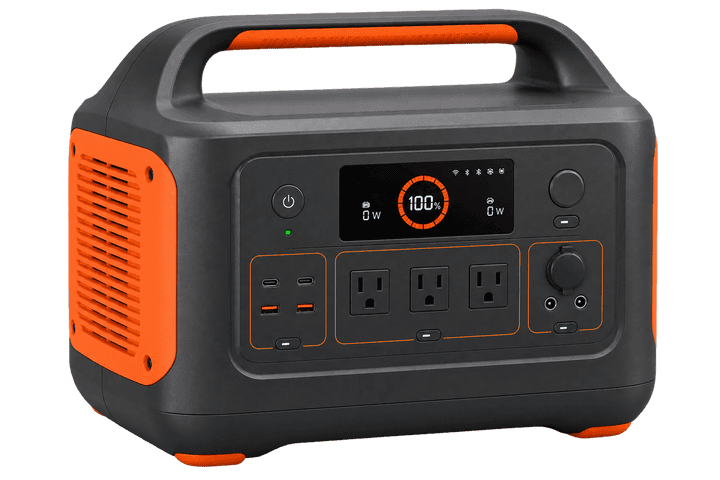
Illustrative image — not an exact product photograph.
- Capacity
- 2,042 Wh
- Output
- 2,200 W
- Weight
- 17.9 kg
Best for: home backup, refrigerator and freezer backup, RV use, camping
Price, availability and current rating are shown on Amazon — PowerMatchLab does not display them because we have not independently verified them. As an Amazon Associate we may earn from qualifying purchases.
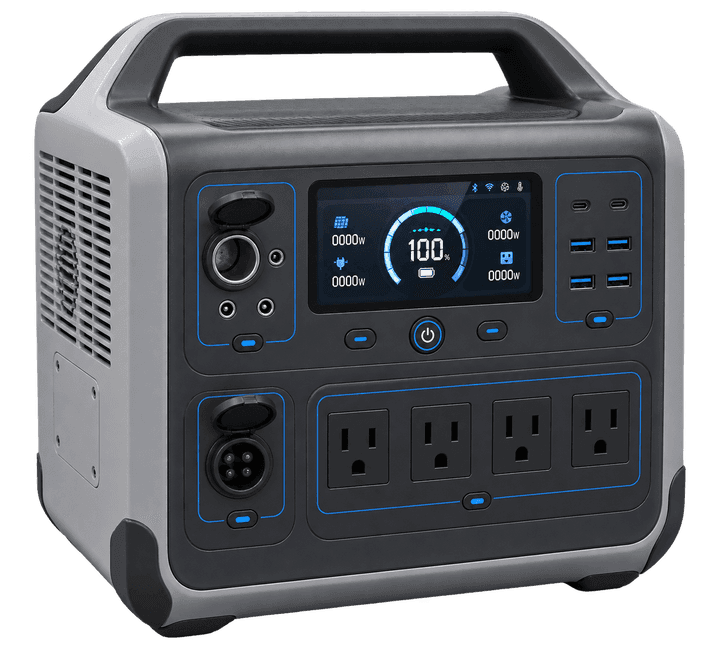
Illustrative image — not an exact product photograph.
- Capacity
- 1,152 Wh
- Output
- 1,800 W
- Weight
- 16 kg
Best for: camping, RV use, refrigerator backup, home emergency backup
Price, availability and current rating are shown on Amazon — PowerMatchLab does not display them because we have not independently verified them. As an Amazon Associate we may earn from qualifying purchases.
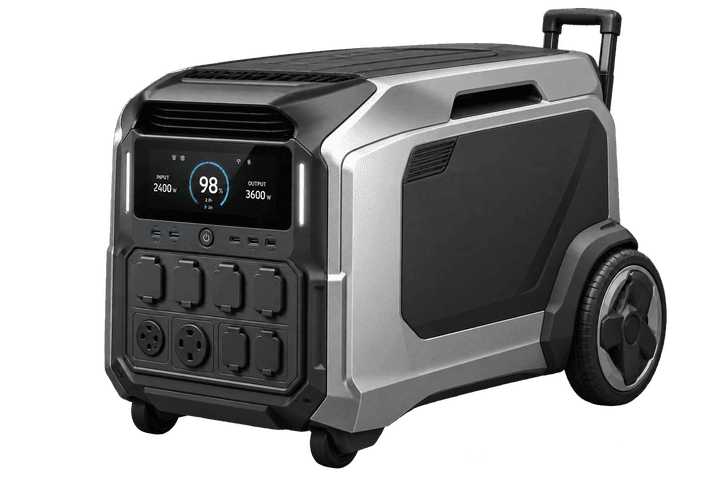
Illustrative image — not an exact product photograph.
- Capacity
- 4,096 Wh
- Output
- 4,000 W
- Weight
- Not verified
Best for: whole-home backup, RV, 240V appliances, extended outages
Price, availability and current rating are shown on Amazon — PowerMatchLab does not display them because we have not independently verified them. As an Amazon Associate we may earn from qualifying purchases.
Related guides
FAQ
- How many watts of solar panel do I need to fully recharge my station in a day?
- As a rough starting point, divide your station's capacity by the number of realistic full-sun hours your location gets, then divide again by your expected real-world derate (commonly 60-80%) to size the panel's rated watts. A local solar-hours estimate for your area will be more accurate than a national average.
- Why is my panel producing far less than its rated watts?
- Rated watts are measured under standardized lab conditions rarely matched outdoors. Angle, temperature, haze, partial shading, cabling, and time of day all reduce real output — 60-80% of rated on a good day is a typical, not a pessimistic, expectation.
- Can I charge from solar and AC at the same time?
- Many stations support simultaneous AC + solar input for a faster combined charge, but not all, and combined input is often capped below the simple sum of both maximums. Check the specific unit's spec sheet.
- Does cloudy weather stop solar charging completely?
- No, but it reduces output substantially — panels still produce some power under cloud cover, just well below their clear-sky output. Plan for meaningfully longer charging time on overcast days rather than assuming zero output.
Sources
- U.S. Department of Energy / NREL — Understanding Solar Photovoltaic System Performance
- Manufacturer charging specifications referenced in products.json
Last updated September 3, 2026. This guide is educational and general; it does not assert product-specific performance beyond what products.json verifies. PowerMatchLab may earn a commission from Amazon links once the Associates programme is active — see the disclosure.